Executive Summary
This technical report documents the creation of flood extent shapefiles for the November 2025 flooding event in Southern Thailand, with particular focus on Hat Yai and surrounding areas in Songkhla Province. The flooding, triggered by extreme precipitation from intensified monsoon activity and the rare Tropical Cyclone Senyar, resulted in significant humanitarian and economic impacts across the region.
Utilizing Synthetic Aperture Radar (SAR) data from Sentinel-1A and RADARSAT-2 satellites, flood extent polygons were generated across 11 acquisition dates spanning October 26 through November 29, 2025. The compiled dataset comprises 63,993 individual flood polygons, which have been merged into a unified maximum flood extent product for visualization and analysis purposes.
1. Event Overview
Event Parameters
| Event Type | Severe Riverine/Pluvial Flooding |
| Location | Hat Yai and Southern Thailand |
| Time Period | October 26 - November 29, 2025 |
| Duration | 34 days of satellite monitoring |
Impact Summary
| Affected Population | 3.6 million people |
| Fatalities | 263 (200 in Songkhla Province) |
| Economic Damage | 100 billion THB (US$3.11 billion) |
| Max Flood Depth | Up to 2 meters in urban areas |
Affected Provinces
- Songkhla - Primary impact zone including Hat Yai urban area
- Nakhon Si Thammarat
- Phatthalung
- Pattani
- Yala
- Narathiwat
- Satun
2. Meteorological Context
2.1 Causative Factors
The November 2025 flood event resulted from a convergence of three major meteorological phenomena:
Northeast Monsoon Intensification
A monsoon trough combined with a low-pressure cell covered Southern Thailand beginning November 19, 2025. This system was reinforced by a high-pressure system from China, creating sustained heavy precipitation across the region.
Tropical Cyclone Senyar
The first designated cyclonic storm in the Strait of Malacca in 135 years formed on November 25, 2025. This rare equatorial cyclone (forming at less than 5 latitude north) intensified unexpectedly from a tropical depression, bringing additional rainfall and storm surge to coastal areas.
La Nina Conditions
A strengthening La Nina pattern contributed to reduced vertical wind shear and an active tropical cyclone season. Combined with warmer global ocean temperatures, this resulted in increased atmospheric moisture and precipitation intensity.
2.2 Rainfall Data
Extreme Precipitation Event - Hat Yai, Songkhla Province
| November 21, 2025 | 335 mm (single day) | Heaviest rainfall in 300 years |
| November 19-21, 2025 | 630 mm (72 hours) | Cumulative 3-day total |
Classification: "Once-in-300-years" rainfall event based on historical precipitation records.
3. Satellite Data Sources
3.1 Primary Sensors
Sentinel-1A (S1A)
| Operator | European Space Agency (ESA) |
| Sensor Type | C-band Synthetic Aperture Radar (SAR) |
| Spatial Resolution | 10 meters (IW mode) |
| Acquisitions Used | 4 scenes |
| Key Advantage | All-weather, day/night imaging capability |
RADARSAT-2 (RD2)
| Operator | Canadian Space Agency / MDA Corporation |
| Sensor Type | C-band Synthetic Aperture Radar (SAR) |
| Spatial Resolution | 3-100 meters (mode dependent) |
| Acquisitions Used | 5 scenes |
| Key Advantage | Multiple polarization modes for enhanced flood detection |
Supplementary SAR Data (BC5)
| Acquisitions Used | 2 scenes |
| Note | Additional SAR dataset for temporal coverage |
3.2 Ancillary Data
| Data Type | Source | Purpose |
|---|---|---|
| Administrative Boundaries | Thai Government | Spatial intersection and attribution |
| Boundary Attributes | Thai Government | Tambon, Amphoe, Province identification |
4. Processing Methodology
4.1 Original Flood Detection (Upstream Processing)
The source KMZ files were generated through standard SAR-based flood detection workflows, likely performed by GISTDA (Geo-Informatics and Space Technology Development Agency), Thailand's national space agency:
- SAR imagery acquisition during active flood event
- Radiometric calibration and terrain correction
- Water surface detection using radar backscatter analysis (low backscatter thresholding)
- Flood extent polygon vectorization
- Intersection with Thai administrative boundaries for attribution
- Export as KMZ files with embedded attribute data
4.2 Flood Extent Compilation (This Analysis)
The following workflow was applied to create a unified maximum flood extent product:
Processing Steps
- Data Import: Load all 11 KMZ source files into QGIS 3.40.0
- Layer Merge: Combine all vector layers (63,993 individual polygons)
- Geometry Validation: Fix invalid geometries using Vector > Geometry Tools > Fix Geometries
- Dissolve: Merge overlapping polygons to single feature using Vector > Geoprocessing > Dissolve
- Simplification: Reduce vertex count for file size optimization while preserving boundary accuracy
- Export: Generate KMZ for Google Earth and GeoJSON for GIS analysis
4.3 Software Environment
| Component | Version | Purpose |
|---|---|---|
| QGIS | 3.40.0-Bratislava | Primary GIS processing |
| GDAL | 3.3.2 | Raster/vector I/O and transformation |
| GEOS | 3.9.1 | Geometry operations |
5. Output Products
5.1 Geographic Extent
Bounding Box (WGS 84)
| West | 99.105 E |
| East | 105.092 E |
| South | 6.052 N |
| North | 17.677 N |
Coordinate Reference System: EPSG:4326 (WGS 84)
5.2 Deliverables
| File Name | Format | Description | Size |
|---|---|---|---|
| hat_yai_flood_extent_merged.kmz | KMZ | Dissolved maximum flood extent polygon | ~1.5 MB |
| hat_yai_flood_final.geojson | GeoJSON | Final flood extent for GIS analysis | ~2.0 MB |
| hat_yai_flood_final.kml | KML | Styled flood extent for Google Earth | ~1.9 MB |
| Source KMZ files (11) | KMZ | Original temporal acquisitions | ~28.6 MB total |
6. Flood Progression Maps
The following satellite-derived flood extent maps show the progression of flooding in the Hat Yai region from initial detection through peak flooding to recession. All maps are centered on Hat Yai (7.0086N, 100.4747E) with a 40-mile radius, displayed over OpenStreetMap basemap for geographic context.
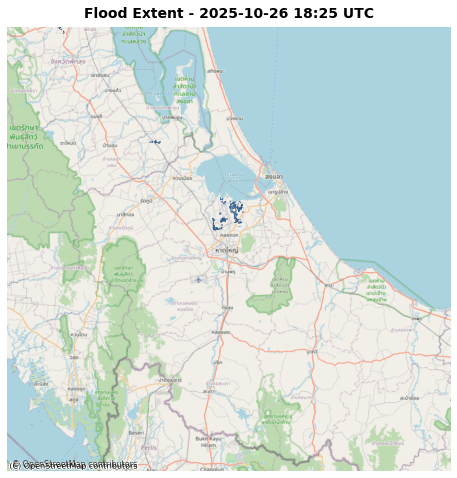
Initial Detection
October 26, 2025 - 18:25 UTC
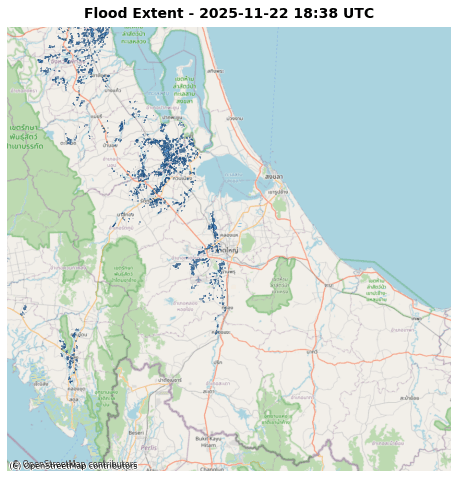
Flood Expansion
November 22, 2025 - 18:38 UTC
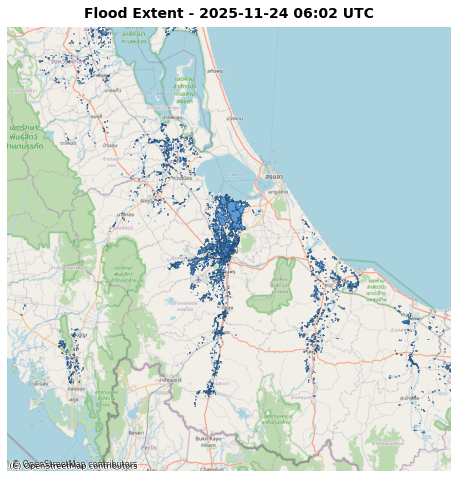
Peak Flooding (Morning)
November 24, 2025 - 06:02 UTC
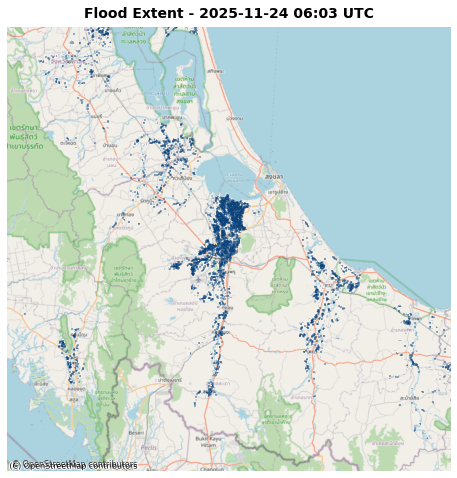
Peak Flooding (Morning)
November 24, 2025 - 06:03 UTC
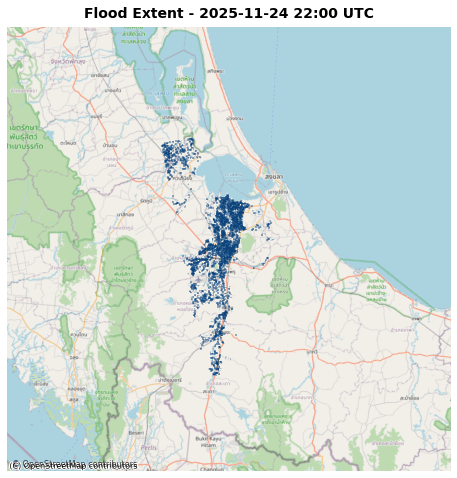
Peak Flooding (Evening)
November 24, 2025 - 22:00 UTC
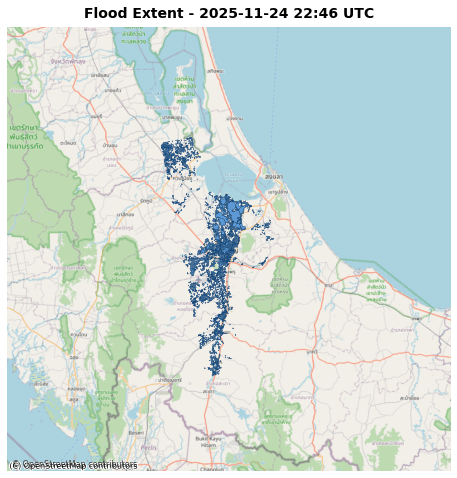
Peak Flooding (Night)
November 24, 2025 - 22:46 UTC
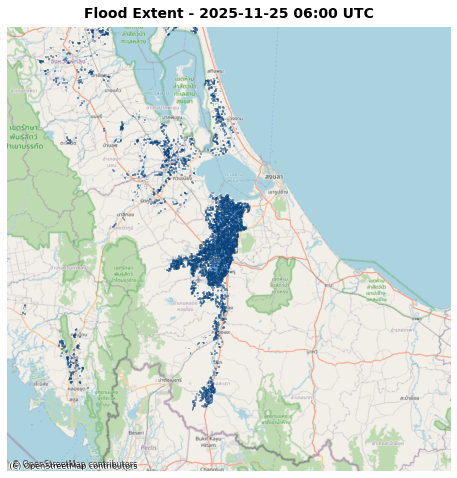
Sustained Flooding
November 25, 2025 - 06:00 UTC
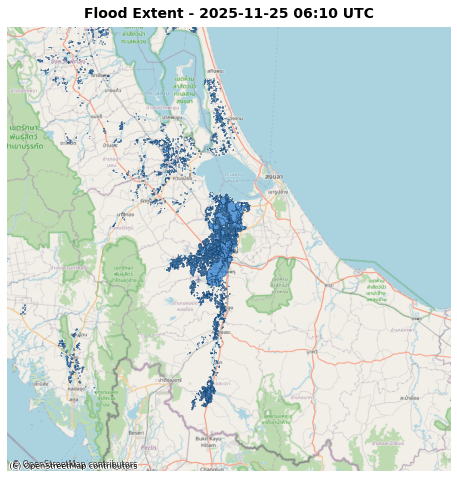
Sustained Flooding
November 25, 2025 - 06:10 UTC
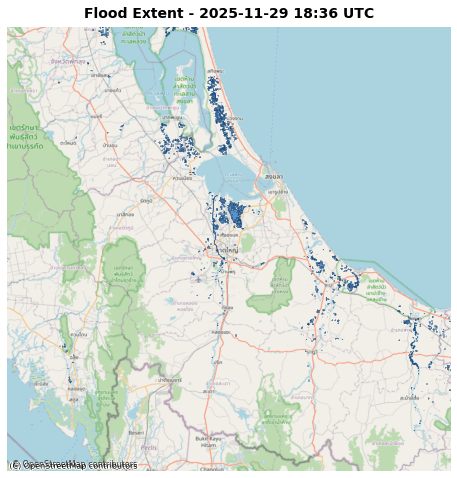
Flood Recession
November 29, 2025 - 18:36 UTC
7. Data Limitations and Caveats
- *SAR Shadow Effects: Radar shadow in mountainous terrain may cause underestimation of flood extent in foothill areas.
- *Urban Areas: Double-bounce effects from buildings can cause false positives in built-up areas.
- *Vegetation Canopy: Dense vegetation may obscure flood water beneath, leading to underestimation.
- *Temporal Gaps: Satellite revisit times mean peak flooding between acquisitions may not be captured.
- *Geometric Accuracy: Source data geometric accuracy is dependent on original processing parameters.
Note: This flood extent mapping represents satellite-observed water surfaces and inherits the limitations of SAR-based detection methods. Ground verification is recommended for critical applications such as damage assessment or insurance claims.
8. References and Attribution
Data Sources
- Copernicus Sentinel-1 data (ESA) - Processed by GISTDA
- RADARSAT-2 Data and Products - MDA Corporation
- Thai Administrative Boundaries - Royal Thai Government
- OpenStreetMap contributors (basemap data)
Processing
- Original flood detection: GISTDA (Thailand)
- Flood extent compilation: Nak Muay Foundation GIS Team
- Map generation: Python (GeoPandas, Contextily, Matplotlib)
News Sources
- Bangkok Post - Southern Thailand Flooding Coverage (November 2025)
- Thai PBS World - Flood Impact Reports
- Reuters - Tropical Storm Senyar Coverage